In the Media: Financial Services Royal Commission

Financial advice and superannuation have been closely examined in the ongoing Financial Services Royal Commission.

Clients and their concerns have been heard through this process, and it’s important that as an industry we learn from what we hear.  The Commissioner will submit his final report to the government by 1 February 2019.

We’ve fully cooperated with the Royal Commission – and whilst it’s been difficult to hear about times in the past where we’ve not done the right thing by our clients, we’re on a journey to grow and change and be better for our clients.  We’ve taken up the challenge set by the Royal Commission to be even better at what we do – taking action to strengthen our systems and processes so these issues don’t happen again.

If you have any questions or concerns specific to your situation, please contact us on 1800 112 324.

Regardless of the Royal Commission, we strive to be better for our clients, 365 days a year. Our focus remains on listening carefully so we can provide them with the products and services they want and need to help them plan for, and live well in, retirement.

SOURCE: https://www.mlc.com.au/personal/blog/2018/09/in_the_media_financ

Seven lessons from the Global Financial Crisis for investors

Key points

  • The key lessons for investors from the Global Financial Crisis (GFC) are that: there is always a cycle; while each cycle is different, markets are pushed to extremes of valuation and sentiment; high returns come with higher risk; be sceptical of financial engineering or hard-to-understand products; avoid too much gearing or gearing of the wrong sort; the importance of proper diversification; and the importance of asset allocation.

Introduction

The period August to October is a time for anniversaries of financial market crises – the 1929 share crash, the 1974 bear market low, the 1987 share crash, the Emerging market/LTCM crisis in 1998, and of course the worst of the Global Financial Crisis in 2008. The GFC started in 2007 but it was the collapse of Lehman Brothers on 15 September 2008 and the events around it which saw it turn into a major existential crisis for the global financial system. Naturally each anniversary begs the question of can it happen again and what are the key lessons. And so it is with the tenth anniversary of the worst of the GFC.

A brief history of the GFC

The events around the failure of Lehman Brothers and the GFC have been done to death. But here’s a brief history. It was the worst financial crisis since the Great Depression. It saw the freezing up of lending between banks, multiple financial institutions needing to be rescued, 50% plus share market falls and the worst post-war global economic contraction. Basically, the environment of low interest rates prior to the GFC saw too many loans made to US homebuyers that set off a housing boom that went bust when rates rose and supply surged.

  • 40% or so of loans went to people with a poor ability to service them – sub-prime and low doc borrowers. And many were non-recourse loans – so borrowers could just hand over the keys to the house if its value fell – “jingle mail”!
  • This was encouraged by public policy aimed at boosting home ownership and ending discrimination in lending. Some extolled the “democratisation of finance”!
  • It was made possible by a huge easing in lending standards and financial innovation that packaged the sub-prime loans into securities, which were then given AAA ratings on the basis that while some loans may default the risk will be offset by the broad exposure. These securities were then leveraged, sold globally and given names like Collateralised Debt Obligations (CDOs). But after securitization there was no “bank manager” looking after the loans.
  • This all came as banks were sourcing an increasing amount of the money they were lending from global money markets.

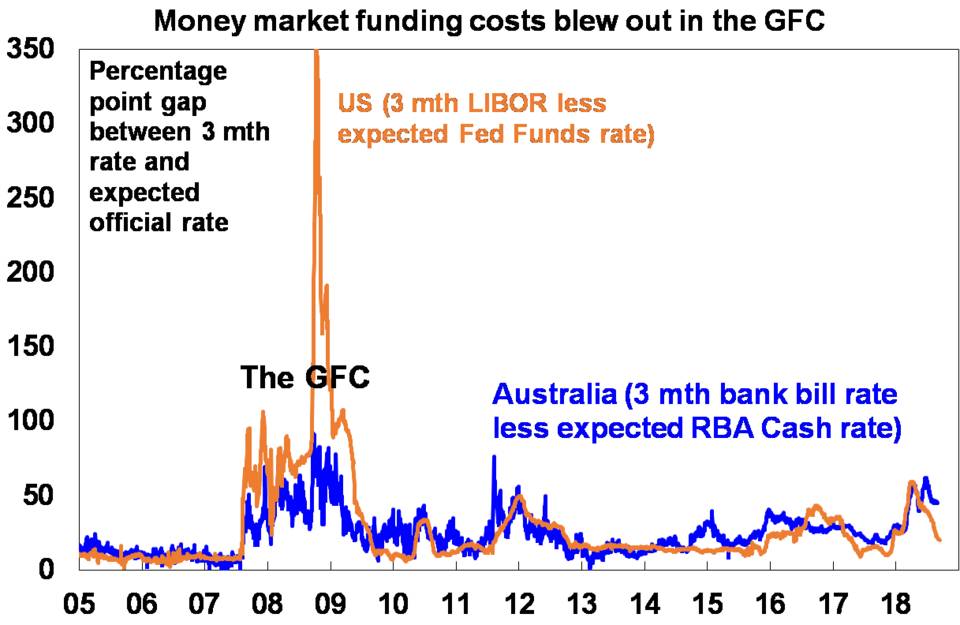
This stopped in 2006 when poor affordability, an oversupply of homes and 17 Fed interest rates hikes saw US house prices start to slide. This made it harder for sub-prime borrowers to refinance their loans after their initial “teaser” rates. So they started defaulting, causing losses for investors. This caught the attention of global investors in August 2007 after BNP froze redemptions from three funds because it couldn’t value the CDOs within them, triggering a credit crunch with sharp rises in the cost of funding for banks – evident in a surge in short term borrowing rates relative to official rates (see next chart) – and a reduction in its availability causing sharp falls in share markets.

Source: Bloomberg, AMP Capital

Shares rebounded but peaked around late October 2007 before commencing roughly 55% falls as the credit crunch worsened, the global economy fell into recession, mortgage defaults escalated, and many banks failed with a big one being Lehman.

The crisis went global as losses magnified by gearing mounted, forcing investment banks and hedge funds to sell sound investments to meet redemptions which spread the crisis to other assets. The wide global distribution of investors in US sub-prime debt led to greater worries about who was at risk, with the loss of trust resulting in a freezing up of lending between banks and sky-high borrowing costs (see the previous chart). All of which affected confidence and economic activity.

The cause of the GFC lay with home borrowers, the US Government, lenders, ratings agencies, regulators, investors and financial organisations for taking on too much risk. It ended in 2009 after massive monetary and fiscal stimulus along with government rescues of banks. But aftershocks continued for years with sub-par growth and low inflation into this decade. From an economic perspective the GFC highlighted that:

  • Fiscal and monetary policy work. There is a role for government, central banks and global cooperation in putting free market economies back on track when they get into a downward spiral. (While some have argued that easy money just benefitted the rich, doing nothing would have likely ended with 20% plus unemployment and worse inequality.) Hopefully there will be the same common sense ‘do whatever it takes’ approach again if the need arises.
  • The return to normal from major financial crises can take time – in fact a decade or so according to a study by Kenneth Rogoff and Carmen Reinhart – as the blow to confidence depresses lending and borrowing and hence consumer spending and investment for years afterwards. The key is to allow for this and not turn off the policy stimulus prematurely, but also to avoid thinking it is permanent as the muscle memory does eventually fade.
  • “Stuff happens” – while after each economic crisis there is a desire to “make sure it never happens again”, history tells us that manias, panics and crashes are part and parcel of the process of “creative destruction” that has led to an exponential increase in material prosperity in capitalist countries. The trick is to ensure that the regulation of financial markets minimises the economic fallout that can occur when free markets go astray but doesn’t stop the dynamism necessary for economic prosperity.

Will it happen again?

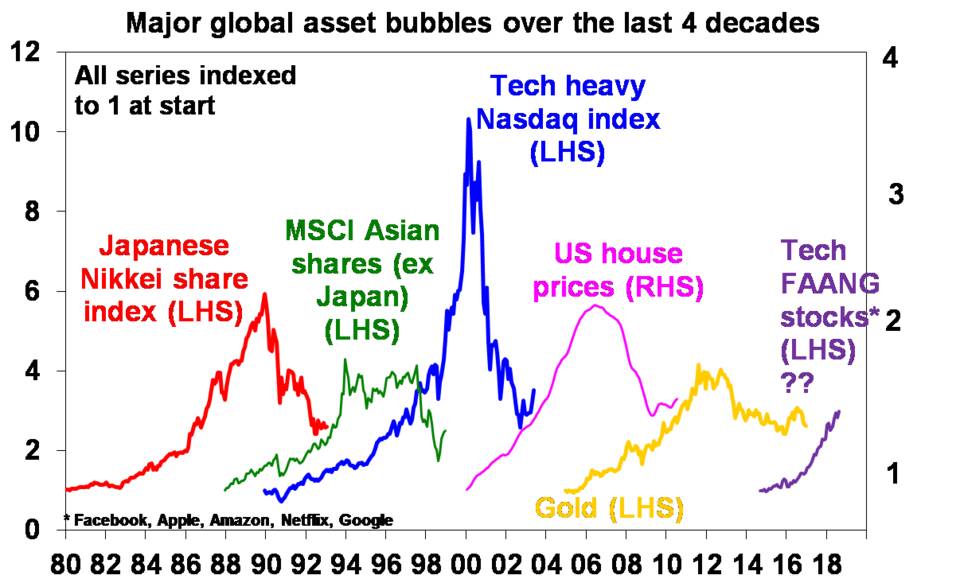
History is replete with bubbles and crashes and tells us it’s inevitable that they will happen again as each generation forgets and must relearn the lessons of the past through another bubble based on collective euphoria about some new innovation. Often the seeds for each bubble are sown in the ashes of the former. Fortunately, in the post-GFC environment seen so far there has been an absence of broad-based bubbles on the scale of the tech boom or US housing/credit boom. There was a brief surge in gold and some commodity prices early this decade but it did not get that big before bursting. Bitcoin and other cryptos were another example but they blew up before sucking in enough investors to have a meaningful global impact. E-commerce stocks like Facebook and Amazon are candidates for the next bust but they have seen nowhere near the gains or infinite PEs seen in the late 1990s tech boom.

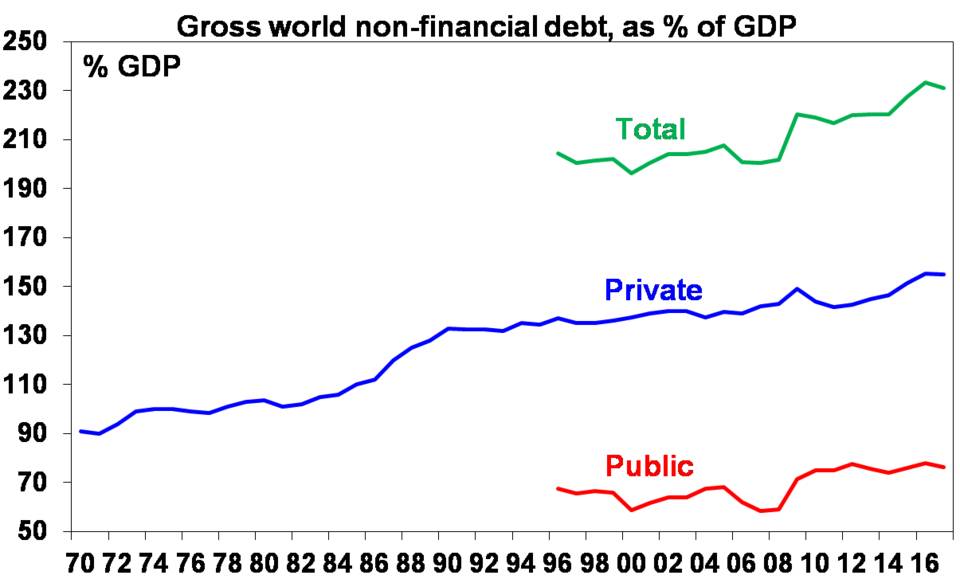
Post a GFC related pull back, global debt has grown to an all-time high relative to global GDP posing an obvious concern. However, this alone does not mean another GFC is upon us. The ratio of global debt to GDP has been trending up forever, much of the growth in debt in developed countries post the GFC has been in public debt and debt interest burdens are low thanks to still low interest rates in contrast to the pre-GFC period. Furthermore, the other signs of excess that normally set the scene for recessions and associated deep bear markets in shares like that seen in the GFC are not yet present on a widespread basis. Inflation is low, monetary policy globally remains easy, there has been no widespread overinvestment in technology or housing, and bank lending standards have not been relaxed as much as prior to the GFC.

Source: IMF, Haver Analytics, BIS, Ned Davis Research, AMP Capital

Moreover, financial regulations have tightened with banks required to have higher capital ratios and get more funds from their depositors. Much of the surge in debt post the GFC has been in private emerging market debt rather than in developed countries suggesting emerging markets are at greater risk.

Another economic crisis is inevitable at some point, but it will likely be very different to the GFC.

Seven lessons for investors from the GFC

The key lessons for investors from the GFC are as follows:

  1. There is always a cycle. Talk of a “great moderation” was all the rage prior to the GFC but the GFC reminded us that long periods of good growth, low inflation and great returns are invariably followed by something going wrong. If returns are too good to be sustainable they probably are.
  2. While each boom bust cycle is different, markets are pushed to extremes – with the asset at the centre of the upswing overvalued and over-loved at the top and undervalued and under-loved at the bottom, which for credit investments and shares was in first half 2009. This provides opportunities for patient contrarian investors to profit from.
  3. High returns come with higher risk. While risk may not be apparent for years, at some point when everyone is totally relaxed it turns up with a vengeance as seen in the GFC. Backward-looking measures of volatility are no better than attempting to drive while just looking at the rear-view mirror.
  4. Be sceptical of financial engineering or hard-to-understand products. The biggest losses for investors in the GFC were generally in products that relied heavily on financial alchemy purporting to turn junk into AAA investments that no one understood.
  5. Avoid too much gearing and gearing or the wrong sort. Gearing is fine when all is well. But it magnifies losses when things reverse and can force the closure of positions at a loss when the lenders lose their confidence and refuse to roll over maturing debt or when a margin call occurs forcing an investor to sell just when they should be buying.
  6. The importance of true diversification. While listed property trusts and hedge funds were popular alternatives to low-yielding government bonds prior to the GFC, through the crisis they ran into big trouble (in fact Australian Real Estate Investment Trusts (REITs) fell 79%), whereas government bonds were the star performers. In a crisis, “correlations go to one” – except for true safe havens.
  7. The importance of asset allocation. The GFC reminded us that what matters most for your investments is your asset mix – shares, bonds, cash, property, etc. Exposure to particular shares or fund managers is second order.

SOURCE: https://www.ampcapital.com/au/en/insights-hub/articles/2018/September/lessons-from-the-GFC

Newsletter – 7th Sep 2018

Dear Sir/Madam,

In office news, Monica is still slowly recovering from her recent surgery and whilst not back in the office just yet, she is working a few hours from home.

We survived our 25km walk on Sunday 19th August, finishing it in just on 5 hours! We copped a strong headwind walking along the Brisbane River but otherwise it was a beautiful day! We thank all our supporters who donated to us which goes towards cancer research!

Here is an article that we thought would be of interest, which pretty much summarises how we assist our clients towards their retirement:

https://www.vanguardinvestments.com.au/retail/ret/articles/insights/research-commentary/retirement-and-superannuation/prepare-for-a-secure-retirement.jsp

To finish off this newsletter, we thought we would share a Friday funny video (you might need Facebook to view it):

https://www.facebook.com/GoggleboxAU/videos/1900477006712981/

Until next month,

Emma (Editor)

Five things you need to know about the Australian economy

Key points

  • The Australian economy grew solidly over the last year.
  • While recession remains very unlikely, the combination of a slowing housing cycle, constraints on consumer spending and still subdued business investment will likely see growth slow going forward to around 2.5-3%.
  • As a result, spare capacity is likely to remain significant, keeping wages growth and inflation low.
  • We don’t expect the RBA to start raising rates until late 2020 at the earliest and the risk remains significant that the next move could be a cut.

Introduction

For years now, many have told us that Australia is heading for an imminent recession. By contrast official forecasts have long been looking for several years of above trend growth. In the event neither has happened and we don’t see them happening anytime soon. Against this backdrop there are five things you should know about the Australian economy.

First – the economy grew solidly over the last year

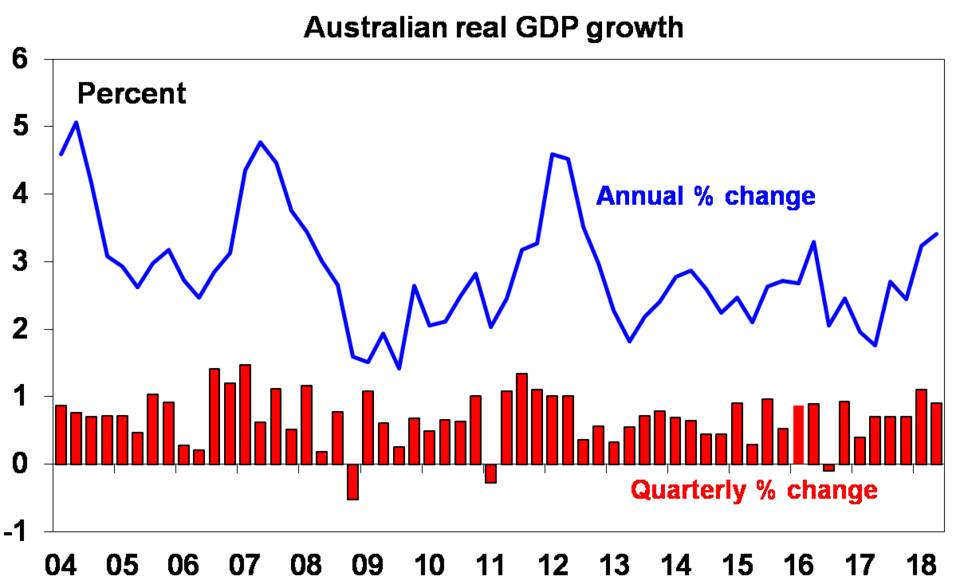
After several years of muddling along the Australian economy actually perked up over the last year with GDP growing a surprisingly strong 3.4% year on year, its fastest since 2012.

Source: ABS, AMP CapitalSource: ABS, AMP Capital
Source: ABS, AMP Capital

That growth has been able to range between just below 2% and just above 3% over the last six years despite a large drag on growth from the fall back in mining investment is actually pretty good. But it’s below the norm for Australia, which has averaged around 3% GDP growth per annum over the very long term. It should also be remembered that strong population growth has been one of the reasons for the relative resilience of Australia’s economy, but over the last year per capita GDP growth at 1.8% has been running below that in the US and in line with that in Europe.

Second – growth is likely to slow a bit from here

While economic growth averaged a strong 1% quarterly pace in the first half of the year it’s likely to slow going forward:

  • The housing construction cycle is turning down as approvals trend down and the cranes come down. Falling alterations and additions won’t help.
  • Growth in consumer spending is likely to slow given weak wages growth, high levels of underemployment and slowing wealth gains as home prices fall. With falling home prices its unlikely that households will be prepared to keep running down the household saving rate – which is now at a 10 year low of just 1% – to make up for weak income growth.
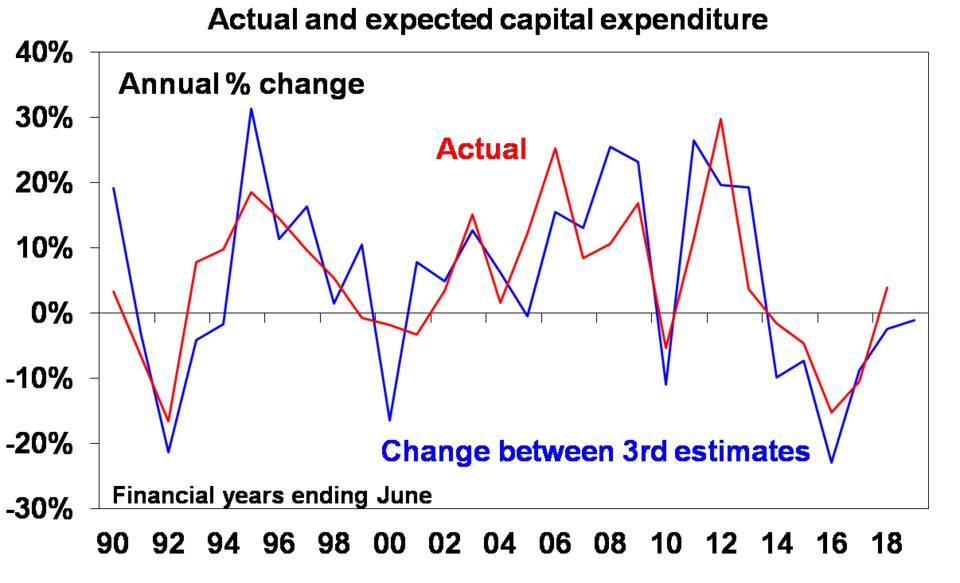
  • Business investment plans for the current financial year are still subdued pointing to roughly flat investment (if plans for this year are compared with those made a year ago) and political uncertainty could start to weigh ahead of a potential change in government.
Source: ABS, AMP Capital
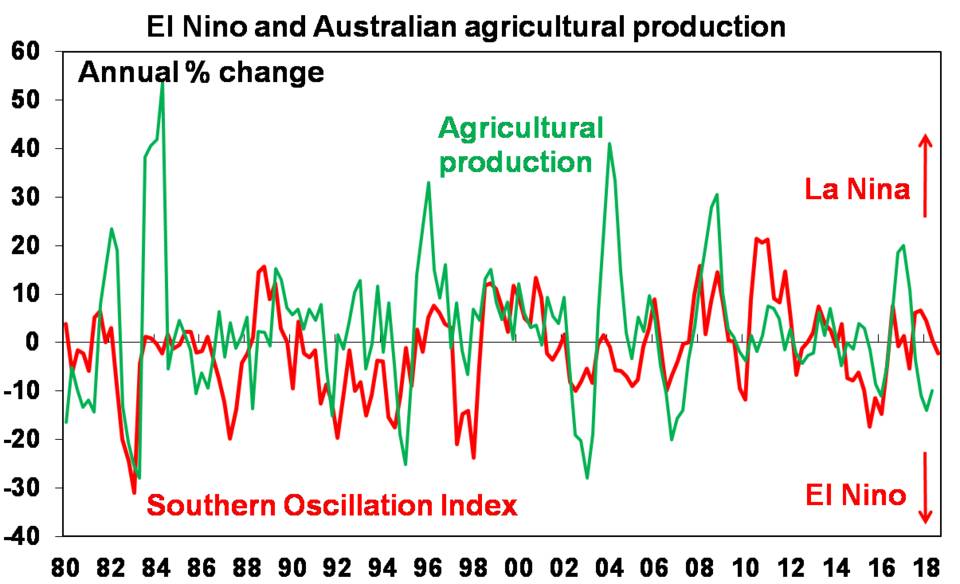
  • Drought could knock 0.5 percentage points off economic growth this year.
 Source: ABS, Bureau of Meteorology, AMP Capital
Source: ABS, Bureau of Meteorology, AMP Capital
  • While agricultural production as a share of GDP is now just 2.5%, a 20% slump in farm production as seen in past droughts would still knock 0.5% off economic growth. If it turns into an El Nino phenomenon it could be worse.

Third – but it’s not going into recession

Despite these drags, recession will continue to be avoided just as it has been over the past 27 years:

  • Over the past five years or so the slump in mining investment back to more normal levels has knocked around 1.5% per annum from GDP growth. However, mining investment is no longer 7% of the economy and it’s near the bottom so its drag on GDP growth is approaching zero.

Source: ABS, AMP Capital
  • Public infrastructure spending is rising and has further to go.
  • Net exports are likely to add to growth as the completion of resources projects boosts resources export volumes, although a US/China trade war is a threat here.
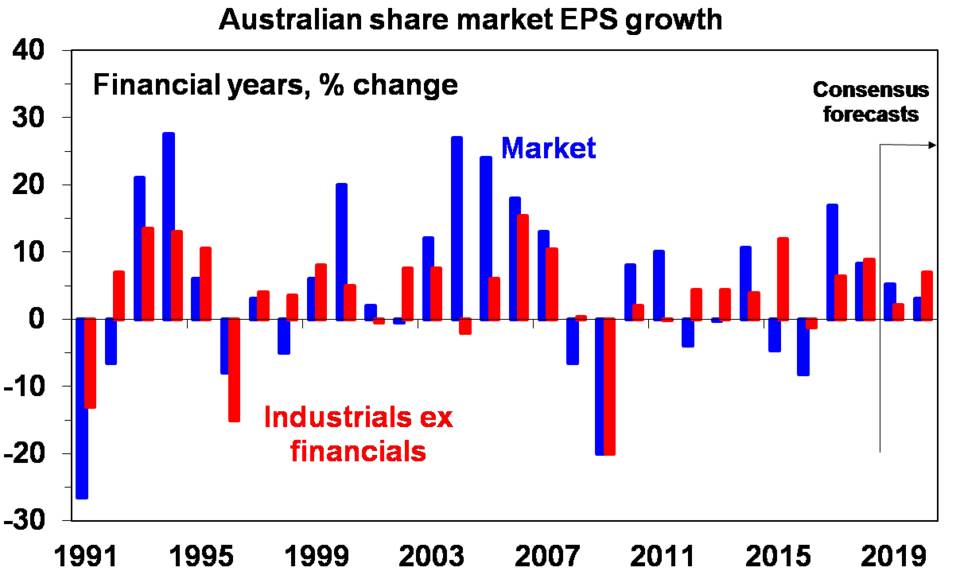
  • Profits for listed companies are rising in contrast to the 2014-16 period. This is a positive for investment.
Source: UBS, AMP Capital
  • While profit growth has slowed from 17% in 2016-17 to around 8% it’s positive and 77% of companies in the recent reporting season (the highest since the GFC) have seen rising profits with 86% of companies raising or maintaining their dividends indicating confidence in the outlook.
Source: AMP Capital
Source: AMP Capital

So while housing construction will slow and consumer spending is constrained, a lessening drag from mining investment and slightly stronger non-mining investment along with solid export growth provide an offset and are expected to see growth between 2.5-3% going forward. Down from over the last year and slower than the RBA expects, but stronger than many doomsters see.

Fourth – spare capacity will remain for a while yet

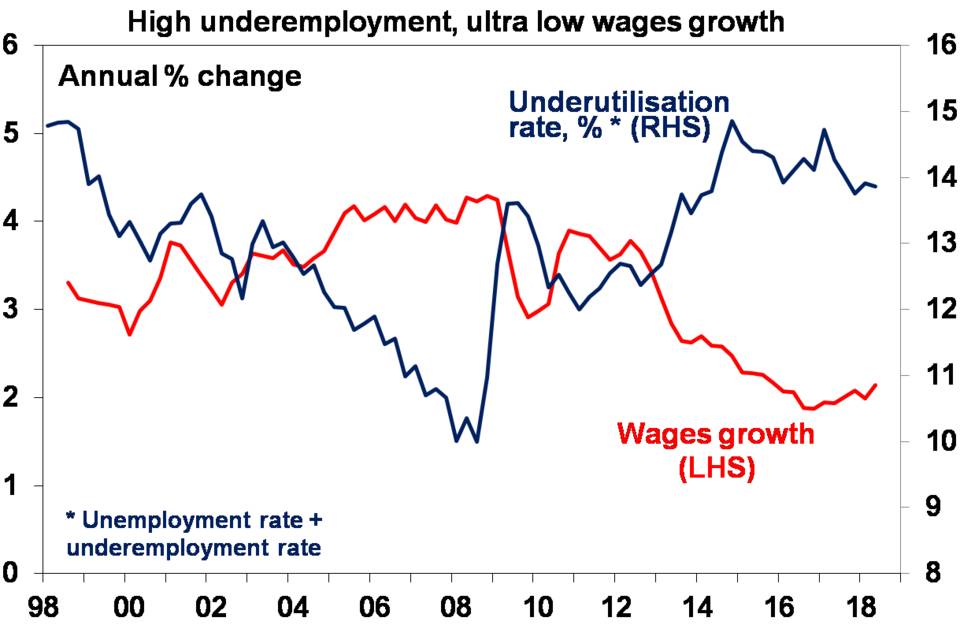
With the economy’s potential (or sustainable) growth rate running around 2.75% and actual economic growth likely to run around this spare capacity in the economy will be with us for a while yet. To use it up we really need a long period of above trend economic growth, but this looks unlikely. Spare capacity remains most obvious in the labour market where the underutilisation rate remains historically high at near 14%. With it likely to remain high for some time to come it’s hard to see much acceleration in wage growth or inflation in the economy.

Source: ABS, AMP Capital

Fifth – which means RBA rate hikes are a long way off

The RBA’s forecasts for continuing solid economic growth and a gradual rise in underlying inflation argue against a rate cut and support the case for an eventual hike. But our more constrained view on growth implying lower for longer wages growth and inflation along with the risks posed by likely further falls in Sydney and Melbourne home prices, tightening bank lending standards and the drought indicate a rate hike is unlikely to be justified any time soon. The next move in rates is probably still up but not until second half 2020 at the earliest and there is a risk that the next move will actually be down if falling home prices pose a significant threat to consumer spending and inflation starts falling again.

Implications for investors

There are several implications for Australian investors.

First, continuing growth should provide support for reasonable returns from Australian growth assets.

Second, bank deposits are likely to provide poor returns for investors for a while yet.

Third, while Australian shares are great for income, global shares are likely to remain outperformers for capital growth.

Finally, the outlook remains for a further fall in the $A. With the RBA comfortably on hold and the Fed raising rates every three months (with the next move coming this month), the interest rate gap between Australia and the US will go further into negative territory making it even more attractive to park money in the US and not Australia which will drag the $A down. Threats to global growth from a trade war and problems in emerging countries will also weigh on the $A.

SOURCE: https://www.ampcapital.com/au/en/insights-hub/articles/2018/September/five-things-Australian-economy


Freelancing or in a startup? Here’s five ways to look after your super

Now that the government has tightened up the amount of money you can get into super via concessionally-taxed contributions, fresh strategies are called for to ensure you’re well-positioned for retirement.

When you strike out on your own, making regular super contributions can be difficult to justify – especially when retirement is seemingly such a long way away. But, Caleb Dozzi of Brisbane-based dozzi Financial Advice says, failing to budget for super is not just a mistake but a missed opportunity – for all ages.

“A lot of people think super is optional but that’s not looking at the real cost of doing business,” he says. It’s also the most tax-efficient way to build long-term wealth.

Yet, the stats show that if you’re self-employed you’re likely to have an under-baked nest egg come the end of your career. Nearly 10% of the workforce is self-employed, but almost one quarter has no superannuation, and those who do are seriously lagging behind. Only 27% of self-employed people in their 60s have more than $100,000 in super compared with 50% of employees who receive the Superannuation Guarantee (SG).1

You don’t want to be one of the statistics, right? You want to live the dream now and later in life. Here’s five tips to make sure you’re building up your superannuation fund while being your own boss:

1. Make super part of your business plan

Before you start a business, it’s important to model your future cash flows, taking into account estimated business income, expenses, your living costs and whether you can afford super on those projections.

“If you’re not contributing to super from day one, then you need a plan for when and how you will incorporate super into your cash flows in future,” says Dozzi.

If you’re incorporated and employed by your own business you’re required to pay yourself the SG, which is currently 9.5% of your employment income. If you’re a sole trader or partner, it’s optional but that doesn’t mean you shouldn’t.

2. Pay yourself first

When Marisa Wikramanayake was ready to enter the workforce in 2008 it was at the height of the GFC. She couldn’t secure a full-time job, so started to freelance and has been a freelance writer ever since.

“It took a long time to get enough income that was not just sufficient for rent but also to put some aside for savings and super,” she says. It wasn’t until last year that she started to think seriously about super.

“I set up a direct debit of $20 a week. I also set up a direct debit of $100 a month into a high interest savings account,” she says. “After I build that up I’ll probably transfer more into super.”

Dozzi agrees that if you receive regular income the best way to funnel money into your super is to set up a direct debit from your bank account aligned with your pay cycle. Otherwise the temptation is to spend the money on yourself or your business.

If your income is lumpy or irregular, you might prefer to transfer part of each payment into super. Alternatively, you can transfer it into a separate bank account and tip it into super quarterly or annually.

All that’s left to do then is decide which super investment option best fits your age, risk tolerance and values, and whether to make your contribution before or after-tax.

Failing to budget for super is not just a mistake but a missed opportunity.

3. Maximise personal pre-tax contributions

If you make personal concessional (pre-tax) contributions to your super fund you can generally claim the full amount as a tax deduction. Concessional contributions are subject to an annual cap of $25,000, with additional tax applying to amounts above the cap. It’s important to note that to be eligible to claim a tax-deduction, you must have first submitted a valid deduction notice to your super fund within required timeframes, and had it acknowledged by your fund in writing.

While contributions tax of 15% (in most cases) will be deducted, the difference between that and your marginal tax rate is your effective risk-free return before you factor in the return on your investments inside super. Say you earn $80,000 a year, which puts you on a marginal tax rate of 32.5c in the dollar. You receive a risk-free return of 17.5c on every dollar of concessional contributions you put into super.

The flip side is that people on lower incomes with an effective tax rate of less than 15% receive no tax benefit from concessional contributions. To counteract this, people earning less than $37,000 may be eligible for a contribution to super up to a cap of $500 under the government’s Low-Income Superannuation Tax Offset scheme.

Even so, some low-income earners may be better off making a non-concessional contribution.

4. When after-tax contributions make sense

Wikramanayake soon realised she would be better off putting her $20 a week into super as a non-concessional contribution. These are after-tax payments up to an annual non-concessional contributions cap of $100,000, or $300,000 in any three-year period2.

Because income tax has already been paid on after tax contributions, contributions tax doesn’t apply. You don’t receive a tax deduction, but non-concessional contributions are still a good way to boost your retirement savings because earnings inside super are taxed at a maximum of 15% rather than your marginal rate.

What’s even better, the government will sweeten the deal with a co-contribution of up to a maximum of $500 for eligible low and middle-income earners. Wikramanayake receives the full $500 which she says more than covers her fund’s management fees.

5. Know your options

You wouldn’t dream of running your business on autopilot, and your super is no different. A recent survey by Investment Trends found that Millennials are not only driving the trend to switch super funds, but they are also more likely to choose a fund with socially aware investment options.3

Even though Wikramanayake’s super balance is still small, she takes an active interest in where it’s invested.

“I go in every quarter and look at my options. I don’t mind a bit of risk; I want to invest in overseas infrastructure and property, and I also want to know my money’s invested in ethical things,” she says.

The reality is that superannuation is a long-term game and you need to start playing early and actively to ensure you have the most rewarding retirement.

SOURCE: https://www3.colonialfirststate.com.au/personal/guidance/growing-your-super/freelancing-or-in-a-startup-heres-five-ways-to-look-after-your-super.html

The Twilight Zone with Trump, Trade Wars and Turkey

Bob Cunneen
Senior Economist & Portfolio Specialist

The calendar year is coming to a close but some markets are struggling to make the finish line in good shape. We’re in a twilight zone where Trump, trade wars and countries like China and Turkey could present risks to Australian investors over coming months. These are important to be aware of, even though the future is beyond prediction.

President Trump’s political challenges could see Wall Street go into reverse

Wall Street is close to the record highs set in January 2018. Indeed the NASDAQ Index, which is dominated by technology shares such as Apple, Amazon and Facebook, has been the best performing share index so far this year. Lower taxes, a strong US economy and mild wages growth has seen corporate profits surge in 2018. Many investors consider this the ‘best of all possible worlds’ for US shares and have piled money into Wall Street.

However this optimism could easily falter. The US mid-term elections in November 2018 could also see Republicans lose control of Congress. If this occurs, the Trump corporate tax cuts may be challenged by the Democrats. The Mueller investigation into collusion with Russia during the 2016 election campaign is also a threat to President Trump’s standing. Hence political risk could dominate both Washington and Wall Street in the final months of 2018.

The US Federal Reserve (Fed) is determined to increase interest rates. The Fed has provided guidance for gradual interest rate rises over the coming year. Yet guidance is not a guarantee. Should US inflation start to sharply rise, the Fed could surprise with more aggressive interest rate rises. Higher interest rates would have a direct impact on company profits, damaging Wall Street prospects and investor returns.

The Trade War is escalating rather than fading

The opening shots in this campaign were President Trump’s twitter line in May that “trade wars are good and easy to win”. Since then, the trade conflict has only intensified. The US has implemented tariffs on steel and aluminium imports and targeted US$50 billion in select Chinese imports. President Trump has threatened another US$200 billion of Chinese imports with tariffs. China has responded with tariffs on US exports.

These tariffs will see US businesses and consumers confront higher prices for imported goods, like mobile phones, computers and toys. Higher prices, which means rising inflation, could further accelerate the pace of interest rate rises from the Fed. This is hardly “good” for the US economy, share markets and interest rates.

The ‘Turkish bath’ for emerging markets

Emerging markets are low income economies with less advanced financial systems. While these economies have strong long-term growth prospects, they also feature higher financial and political risks. China and Turkey are two key emerging economies that have been prominent in 2018.

China’s share markets have disappointed this year with negative returns. The trade war with the US, as well as concerns over high company and local government debt, has seen Chinese share investors become more cautious. China’s economic growth also appears to be slowing, casting doubt over company profit prospects.

Turkey’s financial waters have also become heated. Inflation has been rising and now stands above 15%. That means the average price of goods and services is rising 15% each year. Turkey is also running large budget and trade deficits.

European banks have provided significant capital investments and loans to Turkey. Turkey is also a potent political risk given its proximity to Syria and as a member of Europe’s NATO defence organisation. A key lesson of the Asian Crisis in 1997-98 with Thailand is that even when small components of the global economy break down, they can have dramatic consequences. The potential contagion risk from Turkey to global markets bears watching.

Australia faces some challenges in coming months

Australia’s economy seems to be ending 2018 in better health. Business surveys are positive, there is strong jobs growth and the unemployment rate has fallen to 5.3%.

However Australians are still worried, judging by subdued consumer sentiment surveys and slow retail spending. High electricity prices, the burden of large debt obligations and slow income growth are the key concerns. Add to this a housing market that is cooling, with tighter lending standards coming from the banks. The immediate path ahead for the average Australian is a tough one.

Fortunately the lucky country seems to have a few positives. Exports are still growing and infrastructure spending on road and rail are supporting the economy. However Australia remains dependent on a prosperous global economy. The ‘T’ risks with President Trump, US interest rate tightening, trade wars and Turkey will require vigilance as 2018 comes to a close.

All data current as at 28 August 2018.

SOURCE: https://www.mlc.com.au/personal/blog/2018/08/the_twilight_zonewi

Royal Commission Hearings: Round 5 – Superannuation

The fifth round of Royal Commission public hearings was held Monday 6 August to Friday 17 August 2018.

The Royal Commission is playing an important role in demonstrating that our industry hasn’t always done the right thing by customers.

We have engaged openly and transparently with the Royal Commission. We have listened closely to the questions that were asked, and considered the matters raised seriously.

We accept and welcome that there will be changes to the industry and a stronger regulatory focus. And we are actively making changes to our business that we know will provide our customers with the best possible outcomes over the long term.

The importance of superannuation

Superannuation is a compulsory means of saving for retirement, enabling people to self-fund their lives after leaving the workforce without needing to rely on a government safety net through the Age Pension.

Superannuation is vital for a financially comfortable retirement. For millennials, who will make up two-thirds of the Australian workforce in less than a decade, superannuation will be their biggest asset.

At Colonial First State, we’re proud of the fact that we’ve helped over 1 million Australians with their superannuation, investment and retirement needs since 1988. And we don’t take this responsibility lightly.

While we work through the matters that have been raised in the Royal Commission, our focus is firmly on the best way to continue to provide you with the right support to achieve better outcomes.

SOURCE: https://www3.colonialfirststate.com.au/personal/news-and-updates/latest-from-cfs/royal-commission-round-5.html

Newsletter – 10th Aug 2018

Dear Sir/Madam,

In office news, Rod has returned to work following his hip operation at the end of June. However, Monica is now away on leave following her recent surgery. She is recovering well and will be back on deck in a couple of weeks.

We had a successful Trivia Night in late July to raise funds for our upcoming OneDay to Conquer Cancer 25km Walk, raising just over $400. The walk is happening next Sunday 19th August in Brisbane and myself, Narelle (Rod’s sister), Kerri (Monica’s sister-in-law) and Bec (Monica’s fill-in) will be walking together as a team.

If you would like to support our efforts, any donations will be greatly appreciated. Please see here for more details.

An interesting article that Rod wanted to share with our clients who have children/grandchildren is herewe’re sure you’ll enjoy it.

Until next month,

Emma (Editor)

Infographic: 2017-2018 financial year in review

Take a visual tour of markets during the 2017-2018 financial year – a good year for investors despite rising trade tensions.

Download PDF version

SOURCE: https://www.mlc.com.au/personal/blog/2018/07/infographic_2017-20

Trumponomics and investment markets

Key points

  • So far President Trump has been positive for share markets but this year the focus is increasingly shifting to populist policies with greater risk for investors.
  • The key risks to keep an eye on in this regard relate to trade conflict and the expanding US budget deficit, although the latter is more a risk for when the US economy next turns down.
  • However, the best approach for investors in relation to Trump is to turn down the noise given the often contradictory and confusing news flow he generates.

Introduction

Since Donald Trump was elected President back on November 8, 2016 we have focussed on whether we will see Trump the rabble-rousing populist or Trump the business-friendly pragmatist. Despite lots of noise – particularly via Trump’s frequent tweets – for the most part Trump the pragmatist has dominated so far. But we have clearly seen a swing to Trump the populist this year – raising risks for investors.

So far Trump has been good for markets

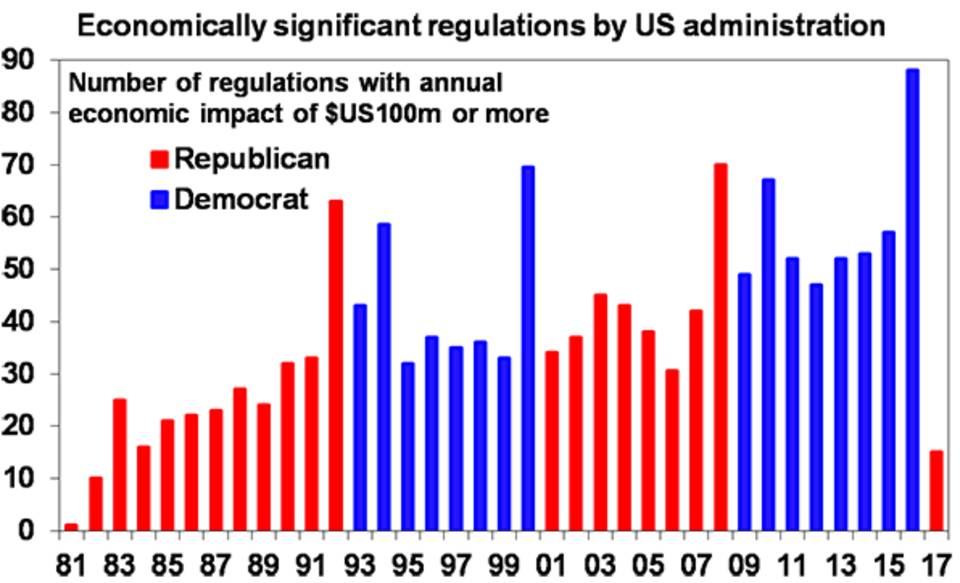
In the period since his election US shares are up 34%, global shares are up 28% and Australian shares are up 21%. While the strength in share markets would have occurred anyway given stronger global growth, US tax reform, fiscal stimulus and deregulation have clearly helped and contributed to the US share market’s outperformance. While US tax reform and tax cuts have received much focus, the Trump administration’s focus on deregulation is equally as significant with the US under Trump seeing the least amount of new economically significant regulation since the Reagan Administration in the early 1980s.

Source: George Washington University, WSJ, AMP Capital

In terms of tax reform and deregulation the Trump Administration has much in common with Reaganomics.

Populism starting to dominate pragmatism

This year though the balance has shifted towards a greater emphasis on populist policies – notably protectionism and criticism of China, the return to sanctions on Iran and arguably recent criticism of the Fed for raising interest rates and pushing up the US dollar. There are several reasons for this shift in emphasis: the pro-business element of Trump’s policies were mainly completed last year; it’s a mid-term election year so Trump is back in campaign mode; Trump’s approval rating has improved despite this year’s controversial policies suggesting firm support for them from his Republican party base; and the strength of the US economy has also emboldened him. In fact, it could be argued that last year was all about bolstering the US economy ahead of this year’s more controversial policies.
The main risks around President Trump centre around five key issues: the rising risk of a full-blown trade war; the expanding budget deficit; the risk of interference in the Fed; the return of sanctions on Iranian oil exports threatening wider Middle East conflict; and the risk Trump ultimately comes into trouble with the Mueller inquiry. We will now look at each of these in turn.

Rising trade war risks

This issue has been done to death but won’t go away. So far the tariff increases actually implemented amount to just 3% of total US imports. While this has been met with proportional retaliation by other countries it’s a long way from a full-blown global trade war. However, the issue is what happens next. Another $US16bn of Chinese imports will likely be hit with a 25% tariff soon and the US is readying a 10% tariff on another $US200bn. Trump is also threatening to raise tariffs on all $US550bn of Chinese imports. China is threatening to retaliate proportionally although it will have to be with other means as it only imports $US130bn from the US. Trump is also threatening to put tariffs on auto imports and looking at Uranium.

News of a deal between the US and the EU to work towards zero tariffs on industrial goods is good news in terms of heading of a full-blown trade war between the two, but negotiations have a long way to go. There was hope of a deal with China in May – with Trump initially crowing about a May 20 trade deal, but since then both China and the US have dug in with Trump tapping popular support for protectionism and anti-Chinese sentiment. So, the trade threat could get still worse before it gets better which means it risks taking the edge off economic growth. Modelling by Citigroup of a 10% tariff hike by the US, China and Europe showed a 2% hit to global GDP after a year. Of course, we are not seeing a tariff hike on all goods but the impact could still be significant if negotiations with the EU and China fail and all the tariffs being talked about are implemented.
There are a few offsetting factors. First, China is moving to provide stimulus to support growth. Second, much of Trump’s approach still looks designed to apply “maximum pressure” to reach a negotiated outcome – and so far so good in relation to Europe. And Trump knows that the costs to US workers (from soybean farmers to Harley Davidson workers) and consumers will escalate as more tariffs are imposed. So, our base case remains that some form of negotiated solution will be reached, but in relation to China this may not occur until next year.

Interference in the Fed and US dollar

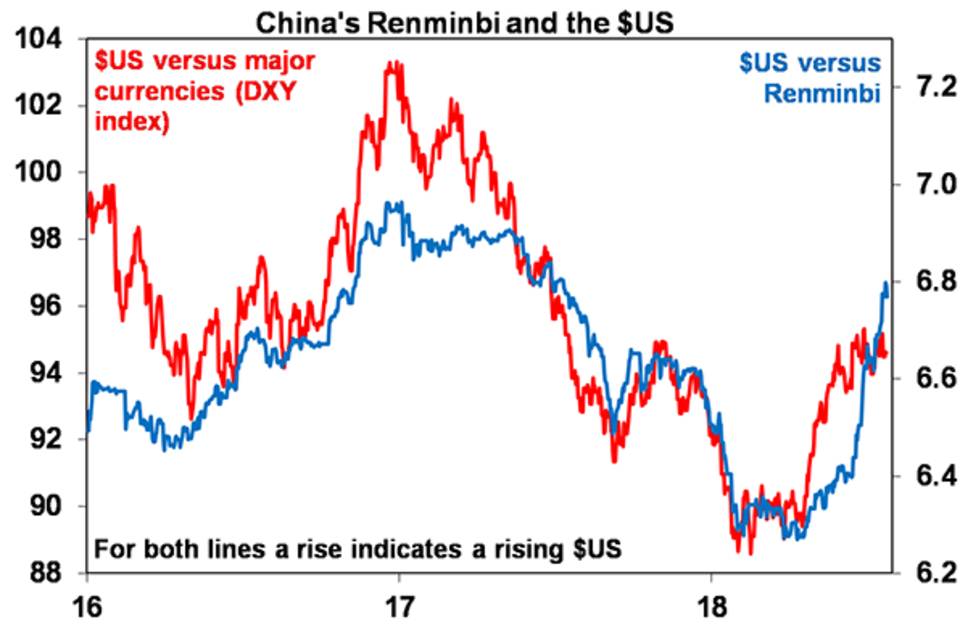
Trump’s recent comments criticising Europe, China and others for helping drive the US dollar up and the Fed for raising interest rates naturally raises concerns that he will intervene in foreign exchange markets and interfere with the Fed. The comments lack economic logic – if “making America great again” means stronger US economic growth then it also means higher US interest rates and a higher US dollar – and maybe the Fed came in for a serve after Fed Chair Powell observed that “countries that have gone in a more protectionist direction have done worse”! Trump’s annoyance may have been triggered by the slide in the value of the Chinese Renminbi. While this looks to be mainly a strong $US story (as the $US is up around 7% against its low earlier this year against a range of currencies compared to an 8% gain against the Renminbi) the Chinese authorities seem quite content to let it fall for now and this will obviously offset Trump’s tariffs on Chinese goods.

Source: Bloomberg, AMP Capital

Despite all this it’s unlikely in the short term that Trump will act on his opinions on rates and the $US. US Treasury Secretary Mnuchin said the administration would “not interfere with the decisions of the Fed or move to manipulate the value of the dollar.” Trump is well known to be a high debt/low interest rate guy so it’s no surprise he is not happy with rising rates. But the Fed answers to Congress, has a mandate to keep inflation down and will do what it sees best – which with strong growth and at target inflation means returning interest rates to more normal levels. However, longer term there is a risk that Trump will weaken the institution of an independent central bank targeting low inflation and may also seek to return to a more interventionist approach regarding the US dollar, particularly if America’s trade deficit refuses to fall. Based on past experience such political intervention would risk much higher inflation which would be a big negative for investment assets as the revaluation that occurred as we moved from high inflation to low inflation would reverse. Fortunately, we are not there yet.

The expanding US budget deficit

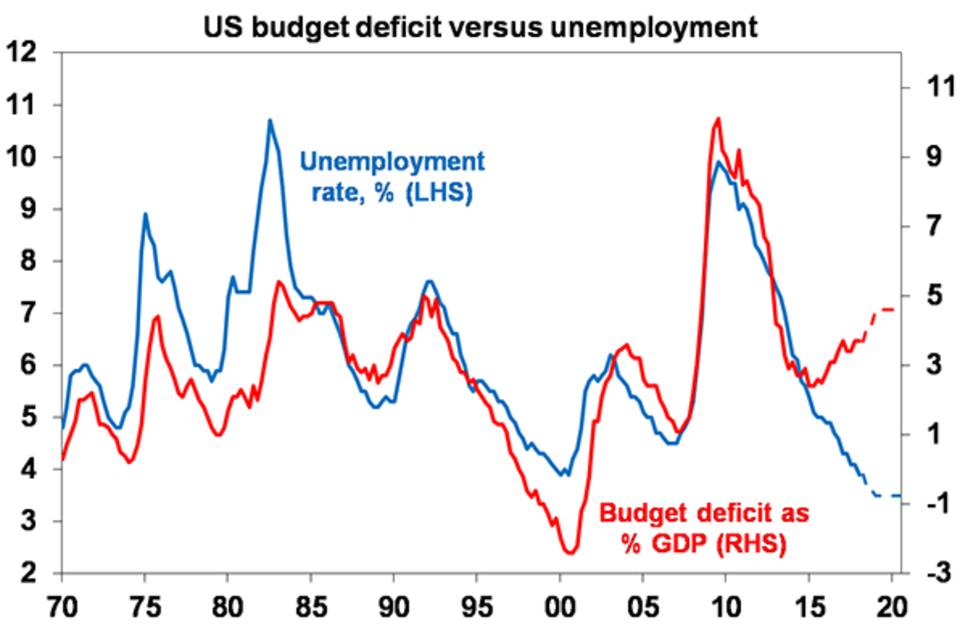
It’s been the norm for the US budget deficit to blow out when unemployment rises (as tax revenue falls and jobless claims go up) and decline when unemployment falls. Thanks to Trump’s fiscal stimulus it’s now blowing out when unemployment is collapsing and looks to be on its way to 5% of GDP. This raises three risks. First, it may mean higher than otherwise interest rates and bond yields as the Fed may have to raise rates more than would otherwise be the case to stop the economy overheating and the Government’s competition for funds results in higher bond yields. So far there is not a lot of evidence of this with US bond yields remaining relatively low – presumably held down by low global bond yields and trade war fears – but its still a risk as US inflationary pressures rise.

Source: Bloomberg, AMP Capital

Second and more fundamentally it begs the question of debt sustainability when the next recession arrives given US public debt is already around 100% of US GDP. Finally, US fiscal stimulus by adding to the US savings-investment imbalance is adding to the US trade deficit and so is completely inconsistent with his trade policies. Even if there was a completely level playing field on world trade America will still have a trade deficit!

The return to sanctions on, and tensions with, Iran

Perhaps a big surprise this year for some has been that President Trump looks to have swapped a half decent deal with Iran for a dodgy one with North Korea. While the latter holds out the hope of (maybe) reducing the threat of a nuclear attack on the US, the return to sanctions and tensions with Iran risks higher oil prices. Since the lows of 2015 oil prices have increased by 70% reflecting increased demand and OPEC’s 2016 cutback. Global stockpiles and spare capacity have been rundown and supply from Libya and Venezuela is uncertain. Our base case is that demand growth will be more constrained from here and that a ramp up in US shale oil production will help contain oil prices around $US70-75 a barrel. The risk though is that the loss of around 800,000 barrels a day of Iranian oil exports and the renewed risk of wider conflict in the Middle East associated with Iran (eg, if Iran closes the Strait of Hormuz through which 20% of global oil supply moves in retaliation against US sanctions) results in higher prices.

The Mueller inquiry into Russian links

Our view in relation to the Mueller inquiry remains that unless Trump has done something very wrong the Republican controlled House will not move to impeach him and even if a Democrat controlled House post the mid-terms did, the Senate will not have the necessary two thirds of votes to remove him from office. However, his sensitivity over the issue, along with his comments seemingly favouring Russian President Putin’s word over US security agencies does remind a bit of Nixon in relation to Watergate. So his removal cannot be ruled out. But this would just mean VP Mike Pence would take over with basically the same economic policies (but with less tweet noise) and economic conditions are stronger than in 1974.

Trump tweet noise

The risks around Trump are real and need to be watched carefully. But Trump generates a lot of noise and much of it is contradictory and confusing – in the last week Trump tweeted “Tariffs are the greatest” only to tweet 12 hours later that “I have an idea for them. Both the US and EU drop all tariffs” – and often reflects bluster ahead of negotiations – recall his “fire, fury and frankly power” threat to North Korea. So the best approach for investors in relation to Trump is to turn down the noise.

SOURCE: https://www.ampcapital.com/au/en/insights-hub/articles/2018/July/olivers-insights-trumponomics-and-investment-markets